Exhibition

Villa Knobloch, today Haus am Waldsee, floor plan 1923
Wo ich wohne
14.6. – 27.9.2026
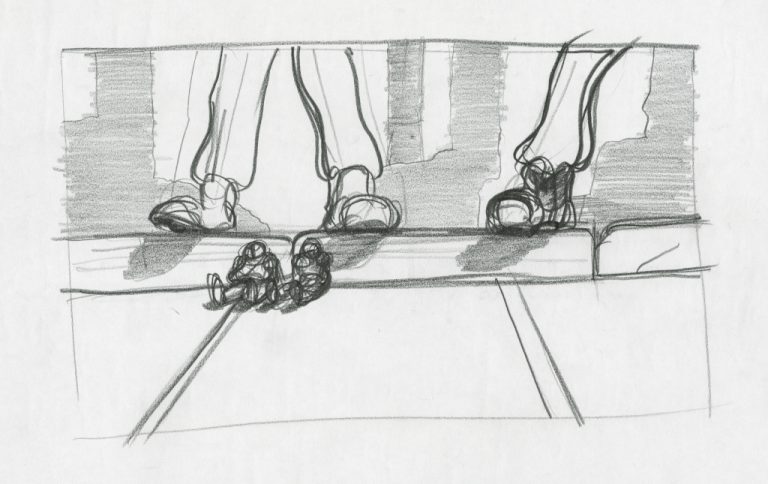
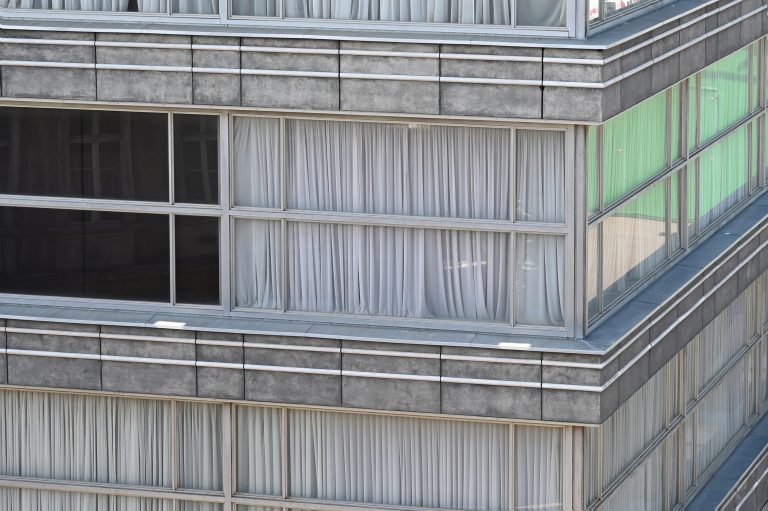
Wo ich wohne reflects on the history of the Haus am Waldsee through its setting, the Villa Knobloch, built in 1922 for the Jewish textile manufacturer Herrmann Knobloch, where mere weeks after the end of the Second World War, the institution found its beginnings. The language of the building, in which both victims and perpetrators of National Socialism lived, is understood not only as a framework, but as a material in its own right – against, with, and through the works in the exhibition disclose ties between the private and the political. The violent events and social struggles of the past century echo in its architecture, its grounds, its location and its agency. They recount an attempt at bourgeois demarcation, clinging to an alleged normality even as the world outside the windows is in turmoil.
The international group exhibition unfolds alongside a spatial intervention by artist Richard Venlet and brings together historical and new works by Nigin Beck, Rhea Dillon, Robert Haas, Hannah Höch, Alexandre Khondji, Atiéna R. Kilfa, Henry Koerner, Yoora Park, Patrick Jolley & Reynold Reynolds, Oskar Schlemmer, Renée Sintenis, Ian Waelder and Frau von Zinowiew.
Curated by
Anna Gritz, Pia-Marie Remmers

Veit Laurent Kurz, Waldsee ca. 1910, colour print based on a photograph by Richard Hoffmann (Bee‘s Eye View), Courtesy the artist
20.2.26 – 17.1.27
Veit Laurent Kurz: Green Sanctuary (C.O.T.B)
14.6 – 27.9.2026
While Veit Laurent Kurz (born 1985 in Erbach, lives and works in Berlin) has predominantly worked with fiction and mythology, in Green Sanctuary (C.O.T.B) he turns to real ecological relationships and actual environments in which differing concepts of nature play out.
C.O.T.B. stands for Circle Of The Bee, an ongoing project developed through the artist’s research platform Die Kette which brings observations of ecology, psychological reflection, and historical enquiry together with the imagined perspective of the bee. The explorations of the project continue in this exhibition by entering into a dialogue with the history of Haus am Waldsee and its natural surroundings.
On the occasion of the institution’s 80th anniversary, Kurz thus turns his attention to its garden, which he understands is both an ecology and a cultural artefact. Drawing on the history of the English landscape garden, he examines how such landscapes are in fact carefully composed cultural constructions, shaped by aesthetic, historical, and ideological conceptions of nature.
The texts and research materials presented on the seven posters function as evidence of a scientific study. These works also propose a speculative shift in perception, inviting reflection on how environments, behaviours, and sensory worlds might appear if the human viewpoint was displaced – this is seen again in how the hybrid, surreal forms of the ceramic water troughs and beehives in the series Bee Fountain bring to mind coral or mould spores.
Luciano Pecoits. Leidenschaftslose Mechaniken
20.2. – 25.5.2026
1946: Still scarred by the destruction of World War II, Haus am Waldsee was established in the villa built in 1922 for the Jewish textile manufacturer Hermann Knobloch. Over the following decades, it would go on to forge an acclaimed exhibition history. In 2026, on the occasion of its 80th anniversary, the institution looks back on its founding years: from its structural conditions, the transformation from a private residence to an exhibition venue, to the ruptures and continuities of the post-war period, and the traces these events have left in the institution’s understanding of itself.
The exhibition Leidenschaftslose Mechaniken by Luciano Pecoits (lives and works between Munich and Vienna) is the first chapter in the exhibition series Since…, developed to mark the anniversary of Haus am Waldsee.
In his practice, the artist uses archival materials and photographic processes to draw conclusions about the conditions of the material’s original context, and how these conditions continue to have an impact on our present. In doing so, he places particular emphasis on provenance research as a method of examining art and the origins and self-images of its institutions.
Pecoits’s newly commissioned works are the result of more than two years of research into the history of the Haus am Waldsee building. Based on administrative documents from the post-war years, such as files from restitution and denazification proceedings, the works trace a fine web of key figures and change of ownership. Accompanied by reproductions of the few preserved photographs of the building as a private residence, the artist reveals the extent to which the house was involved in political power structures and National Socialist networks, and how these connections remained influential throughout the post-war period and beyond.
The exhibition is presented in the café, the villa’s former garage, on a display architecture designed by Georgian curator and archivist Nina Akhvlediani (lives and works in Tbilisi), which allows for flexible forms of presentation. Leidenschaftslose Mechaniken is the first of three exhibition chapters that will be showcased on the display structure throughout the year. Developed by different artists, the exhibitions in the series highlight new perspectives on the history of the institution.
Funded by the Kulturstiftung des Bundes (German Federal Cultural Foundation).
Funded by the Beauftragter der Bundesregierung für Kultur und Medien (Federal Government Commissioner for Culture and the Media).

Supported by: