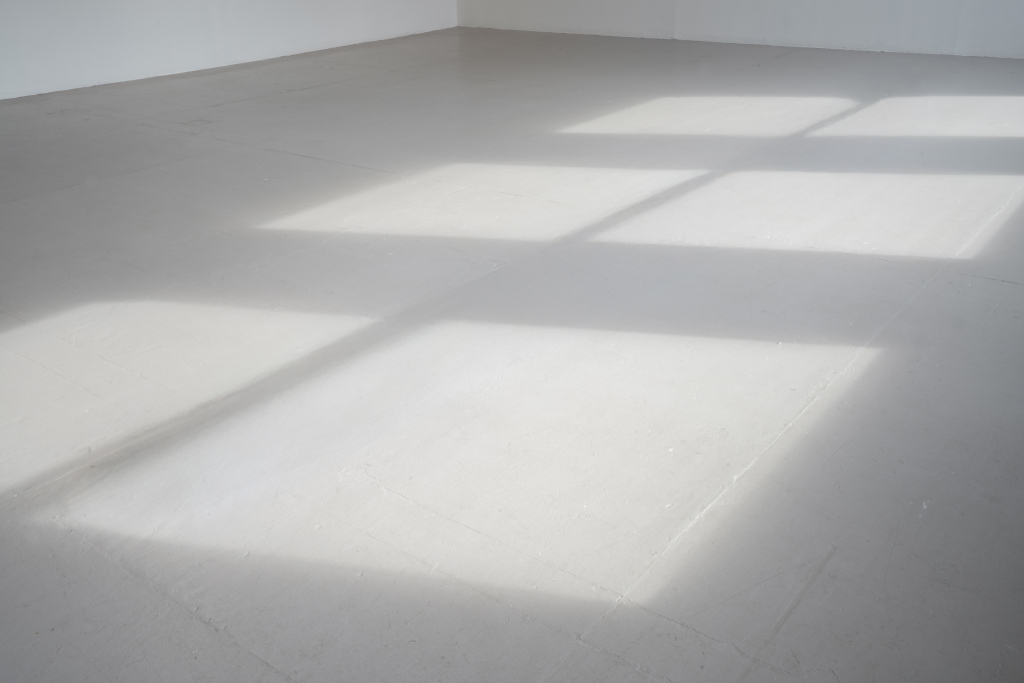
Gianna Surangkanjanajai, Removed, 2025, Courtesy the artist
Gianna Surangkanjanajai
Open
20.2. – 25.05.2026
Gianna Surangkanjanajai (born in Cologne; lives in New York) works primarily in sculpture. Her artworks emerge from situations where material, space, and action intertwine. She does not approach sculpture as a fixed state but as a process which cannot be fully predetermined.
Her point of departure is often simple geometric volumes that contain and constrain materials. Yet within these structures, liquids, paint, or other substances respond to light, temperature, and gravity. Tensions surface, physical states shift, and internal orders are set in motion. These dynamics remain visible and continue to develop over time, without resolving into a final form.
For her exhibition at Haus am Waldsee, Surangkanjanajai has developed a group of new works, based on four large-scale Plexiglas cubes filled with industrial paint. Even at rest the mass of liquid paint exerts force on the geometric structures: the paint’s density produces a constant pressure on the cube’s walls and adhesive seams, which only increases with movement – deformation or structural failure are always latent possibilities.
The sculptures are titled Push. They emerge from a performative action with the paint-filled volumes. Placed on dollies, the cubes are pushed into the exhibition space and released. Where they come to rest is determined by weight, velocity, and the specific conditions of the room. Traces of this event remain legible inside the volumes: paint that struck the walls and then settled has left streaks across the surfaces.
In another space, Surangkanjanajai has installed a movable wall that can be repositioned by visitors along a ceiling track. Its movement alters the spatial conditions of the room: proportions change, the light varies, passages narrow or open up, routes are blocked or redirected.
The mobile wall is covered with a light-coloured camouflage pattern, originally designed to allow things and persons to blend into their surroundings. In this work, however, that promise is undermined. While the pattern suggests concealment, the wall is unmistakably present in how it divides the space. The military and pop-cultural associations of camouflage remain active in the work, but rather than commenting on or neutralising these references, Surangkanjanajai places them in a spatial situation in which the claim to invisibility fails through the very act of its own articulation.
Both the Push sculptures and the movable wall sustain an open field of enquiry, in which the formal and conceptual aspects of the artwork develop and unfold without being directed towards an outcome. This processual logic is echoed in how the exhibition’s title changes over time. Before the opening, the exhibition is titled Upcoming; during its run, Open; and after its conclusion, Closed. These titles do not describe a narrative sequence as much as point to time as a condition through which meaning continually reorganises itself.
Surangkanjanajai is less concerned in her practice with exploring site-specificity than with addressing more fundamental questions: how actions give rise to form, how materials respond to intervention, and how meaning emerges from the interaction of these factors. Her openness is not a sign of indeterminacy, but a deliberate refusal to fix the present moment. Uncertainty, chance, and resistance come to be seen as productive conditions of aesthetic experience.
Curated by
Beatrice Hilke
Supported by: