
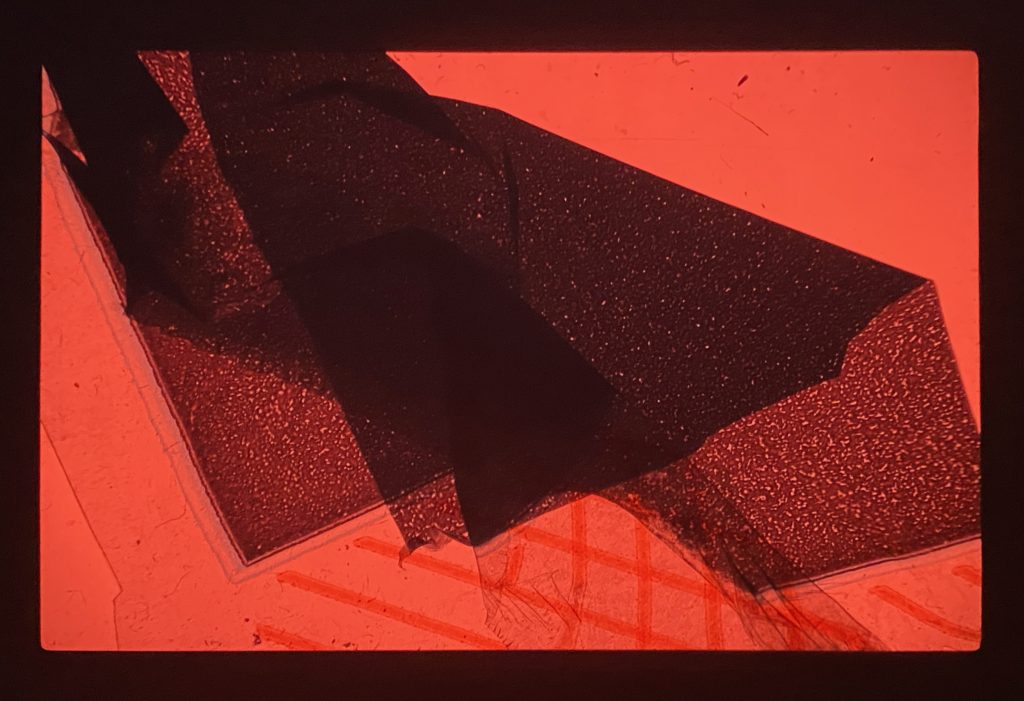
Rey Akdogan, Single slide from Carousel #10, 2025, lighting gels, assorted colored packaging materials held together by slide frames, 13 min. loop (80 slides), dimensions variable. Courtesy the artist and Galerie Anke Schmidt, Cologne
Rey Akdogan
Carousels
20.2. – 25.5.2026
Rey Akdogan (born in Heilbronn; lives in New York) works with materials and image-making processes that shape our visual present. Her practice examines how atmospheres and moods are produced, how colour, light, and material properties influence perception, and which technical and economic conditions structure these processes. Her works frequently take spatially oriented forms, moving between projection, sculpture, and installation.
At the centre of the exhibition at Haus am Waldsee are Akdogan’s Carousel works, which she has been developing since 2010. In these works, her material-aesthetic investigations are condensed into a focused, temporally organised form. Each Carousel consists of a sequence of eighty handmade 35 mm slides rotating in a commercially available Kodak slide projector. Akdogan opens the slide mounts, arranges fragile assemblages within their apertures, and closes them again without adhesive or fixation. Thus the resulting images do not derive from photographic images but emerge from material superimpositions and the transmitted light of the projector.
The starting point for these arrangements is material drawn from industrial, commercial, and scenographic contexts: colour filters, printed plastics, Mylar film, and fluorescent tubes used in stage design, film, advertising, and display architecture. In their original settings, these materials serve to direct vision, regulate transitions, and establish visual consistency, without being consciously perceived as such. In Akdogan’s works, they are released from these functional contexts and integrated as autonomous, formative elements. Through stretching, cutting, folding, layering, or overlaying, she further processes the materials, focusing on their concrete material properties: surfaces, colour values, transitions, and seams, which transform into lines, grids, or rhythmic structures within the projected image.
Alongside transparent colour gels, Akdogan also employs packaging remnants that more often have been printed using industrial CMYK processes. These materials were not originally intended for projection and alter in their colour as light passes through them: white becomes brown, yellow darkens towards black. With each rotation, tonal relations change; lines and structures find new alignments. Familiar surfaces lose their visual stability, while remaining tied to their material origins. The steady clicking of the projector establishes a rhythm that invites a concentrated, slowed mode of viewing and unfolds through the interaction of multiple projections within the space.
For the exhibition at Haus am Waldsee, Akdogan has developed a new work, Carousel #11, which incorporates elements of the building’s architecture. The stone tile pattern of the historic winter garden floor is extracted from its fixed spatial context and broken down into structural components. Recurrent forms enter the temporal order of the Carousel and recombine with each rotation.
This engagement continues in a light installation produced specifically for the winter garden. A low-mounted light fixture with reflectors scans the surface of the floor, bringing focus to the grey-and-white pattern and transforming it into a fleeting field of light. Akdogan’s interest here lies less in atmospheric staging than in the material and formal details that determine the space. Through this shift in attention, a reflective distance opens up from which the conditions of the space can be perceived anew.
The exterior of the house is also integrated into the exhibition. Suspended from the balcony railing, Akdogan has installed industrially produced slit curtains in a shimmering copper, of the kind used in stage productions. Spanning the full width of the balcony, the work is exposed to wind, weather, and wear. Change, deformation, and loss become integral to the work, extending the exhibition’s processual dimension into the outdoor space of Haus am Waldsee.
Curated by
Beatrice Hilke
Trailer Rey Akdogan. Carousels
Supported by: