
Exhibition
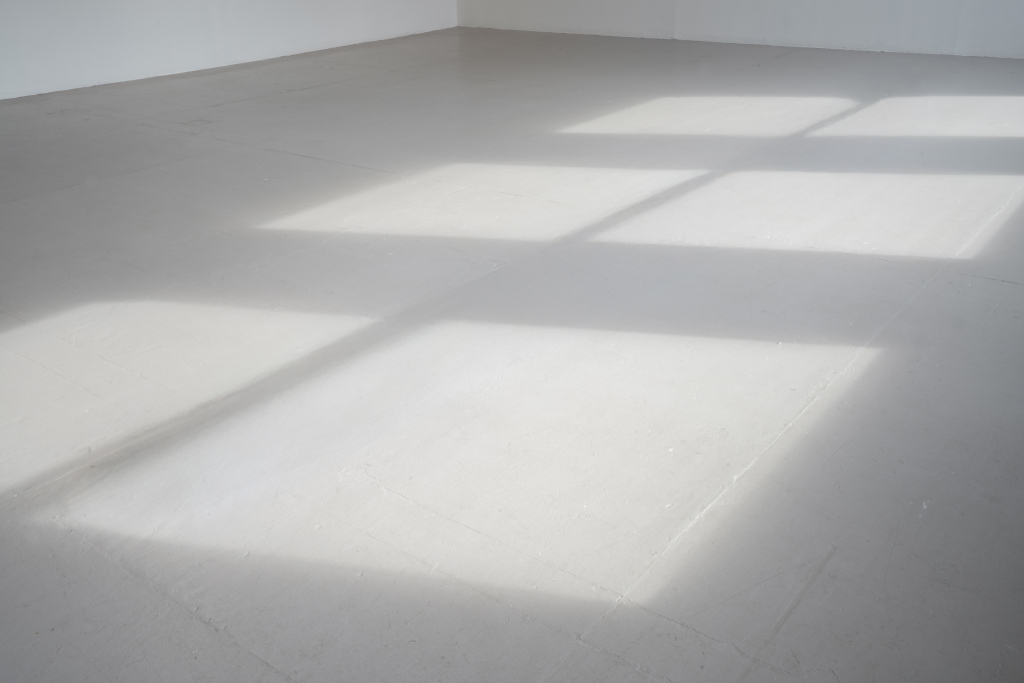
Gianna Surangkanjanajai, Removed, 2025, Courtesy the artist
Gianna Surangkanjanajai
Open
20.2. – 25.05.2026
Gianna Surangkanjanajai (born in Cologne; lives in New York) works primarily in sculpture. Her artworks emerge from situations where material, space, and action intertwine. She does not approach sculpture as a fixed state but as a process which cannot be fully predetermined.
Her point of departure is often simple geometric volumes that contain and constrain materials. Yet within these structures, liquids, paint, or other substances respond to light, temperature, and gravity. Tensions surface, physical states shift, and internal orders are set in motion. These dynamics remain visible and continue to develop over time, without resolving into a final form.
For her exhibition at Haus am Waldsee, Surangkanjanajai has developed a group of new works, based on four large-scale Plexiglas cubes filled with industrial paint. Even at rest the mass of liquid paint exerts force on the geometric structures: the paint’s density produces a constant pressure on the cube’s walls and adhesive seams, which only increases with movement – deformation or structural failure are always latent possibilities.
The sculptures are titled Push. They emerge from a performative action with the paint-filled volumes. Placed on dollies, the cubes are pushed into the exhibition space and released. Where they come to rest is determined by weight, velocity, and the specific conditions of the room. Traces of this event remain legible inside the volumes: paint that struck the walls and then settled has left streaks across the surfaces.
In another space, Surangkanjanajai has installed a movable wall that can be repositioned by visitors along a ceiling track. Its movement alters the spatial conditions of the room: proportions change, the light varies, passages narrow or open up, routes are blocked or redirected.
The mobile wall is covered with a light-coloured camouflage pattern, originally designed to allow things and persons to blend into their surroundings. In this work, however, that promise is undermined. While the pattern suggests concealment, the wall is unmistakably present in how it divides the space. The military and pop-cultural associations of camouflage remain active in the work, but rather than commenting on or neutralising these references, Surangkanjanajai places them in a spatial situation in which the claim to invisibility fails through the very act of its own articulation.
Both the Push sculptures and the movable wall sustain an open field of enquiry, in which the formal and conceptual aspects of the artwork develop and unfold without being directed towards an outcome. This processual logic is echoed in how the exhibition’s title changes over time. Before the opening, the exhibition is titled Upcoming; during its run, Open; and after its conclusion, Closed. These titles do not describe a narrative sequence as much as point to time as a condition through which meaning continually reorganises itself.
Surangkanjanajai is less concerned in her practice with exploring site-specificity than with addressing more fundamental questions: how actions give rise to form, how materials respond to intervention, and how meaning emerges from the interaction of these factors. Her openness is not a sign of indeterminacy, but a deliberate refusal to fix the present moment. Uncertainty, chance, and resistance come to be seen as productive conditions of aesthetic experience.
Curated by
Beatrice Hilke
Supported by:


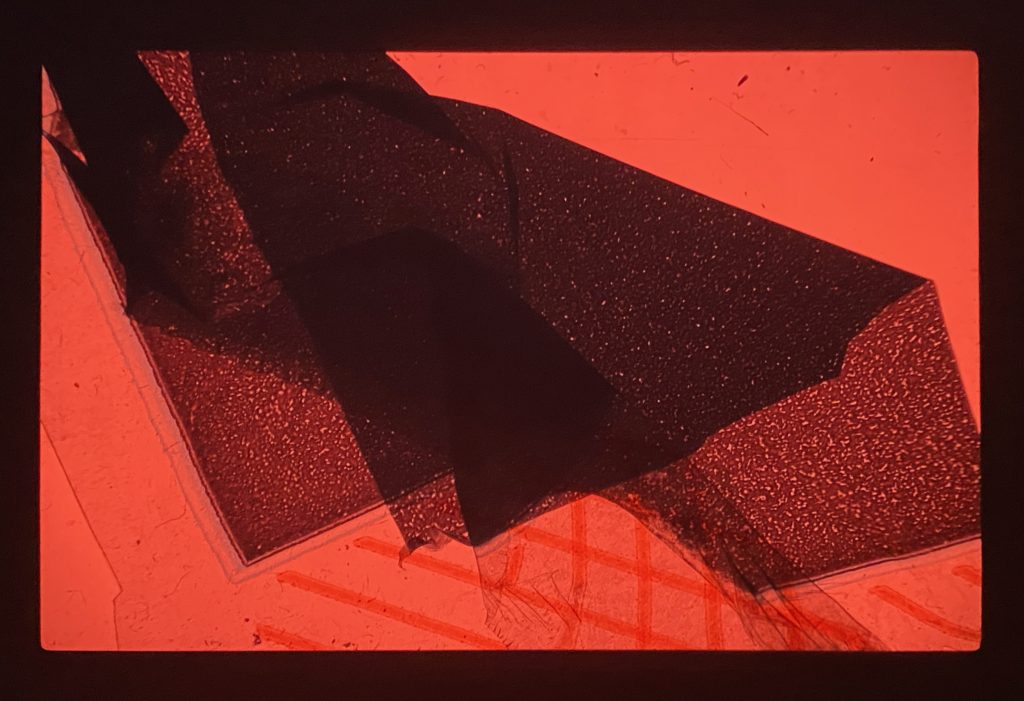
Rey Akdogan, Single slide from Carousel #10, 2025, lighting gels, assorted colored packaging materials held together by slide frames, 13 min. loop (80 slides), dimensions variable. Courtesy the artist and Galerie Anke Schmidt, Cologne
20.2. – 25.5.2026
Rey Akdogan (born in Heilbronn; lives in New York) works with materials and image-making processes that shape our visual present. Her practice examines how atmospheres and moods are produced, how colour, light, and material properties influence perception, and which technical and economic conditions structure these processes. Her works frequently take spatially oriented forms, moving between projection, sculpture, and installation.
At the centre of the exhibition at Haus am Waldsee are Akdogan’s Carousel works, which she has been developing since 2010. In these works, her material-aesthetic investigations are condensed into a focused, temporally organised form. Each Carousel consists of a sequence of eighty handmade 35 mm slides rotating in a commercially available Kodak slide projector. Akdogan opens the slide mounts, arranges fragile assemblages within their apertures, and closes them again without adhesive or fixation. Thus the resulting images do not derive from photographic images but emerge from material superimpositions and the transmitted light of the projector.
The starting point for these arrangements is material drawn from industrial, commercial, and scenographic contexts: colour filters, printed plastics, Mylar film, and fluorescent tubes used in stage design, film, advertising, and display architecture. In their original settings, these materials serve to direct vision, regulate transitions, and establish visual consistency, without being consciously perceived as such. In Akdogan’s works, they are released from these functional contexts and integrated as autonomous, formative elements. Through stretching, cutting, folding, layering, or overlaying, she further processes the materials, focusing on their concrete material properties: surfaces, colour values, transitions, and seams, which transform into lines, grids, or rhythmic structures within the projected image.
Alongside transparent colour gels, Akdogan also employs packaging remnants that more often have been printed using industrial CMYK processes. These materials were not originally intended for projection and alter in their colour as light passes through them: white becomes brown, yellow darkens towards black. With each rotation, tonal relations change; lines and structures find new alignments. Familiar surfaces lose their visual stability, while remaining tied to their material origins. The steady clicking of the projector establishes a rhythm that invites a concentrated, slowed mode of viewing and unfolds through the interaction of multiple projections within the space.
For the exhibition at Haus am Waldsee, Akdogan has developed a new work, Carousel #11, which incorporates elements of the building’s architecture. The stone tile pattern of the historic winter garden floor is extracted from its fixed spatial context and broken down into structural components. Recurrent forms enter the temporal order of the Carousel and recombine with each rotation.
This engagement continues in a light installation produced specifically for the winter garden. A low-mounted light fixture with reflectors scans the surface of the floor, bringing focus to the grey-and-white pattern and transforming it into a fleeting field of light. Akdogan’s interest here lies less in atmospheric staging than in the material and formal details that determine the space. Through this shift in attention, a reflective distance opens up from which the conditions of the space can be perceived anew.
The exterior of the house is also integrated into the exhibition. Suspended from the balcony railing, Akdogan has installed industrially produced slit curtains in a shimmering copper, of the kind used in stage productions. Spanning the full width of the balcony, the work is exposed to wind, weather, and wear. Change, deformation, and loss become integral to the work, extending the exhibition’s processual dimension into the outdoor space of Haus am Waldsee.
Curated by
Beatrice Hilke
Supported by:
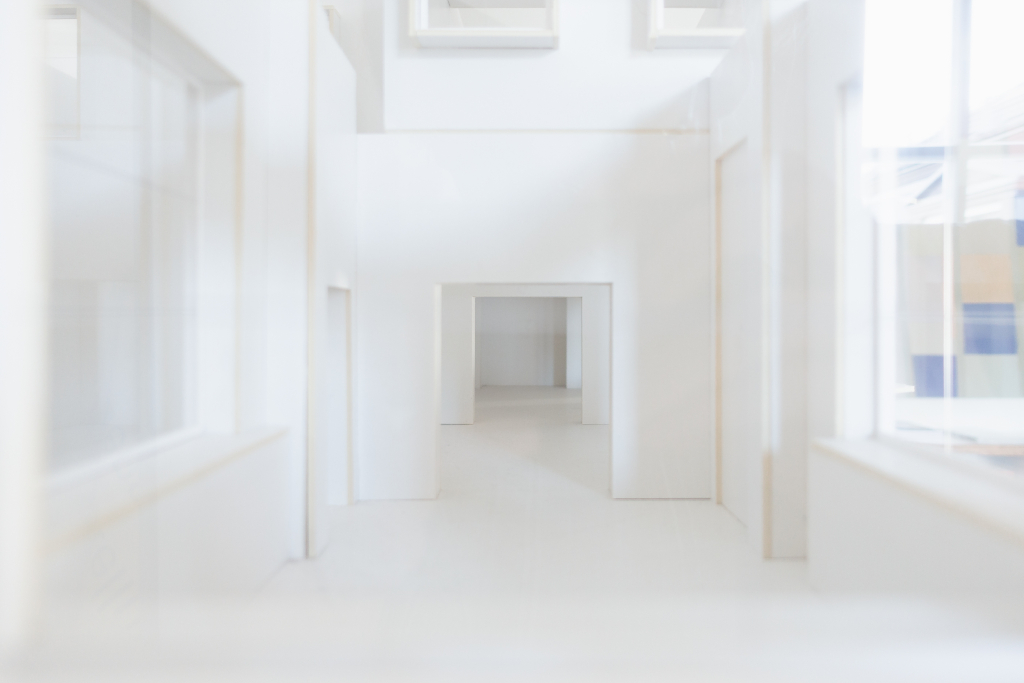
Luciano Pecoits, Research Image, 2025, Courtesy the artist
20.2.26 – 17.1.27
Luciano Pecoits. Leidenschaftslose Mechaniken
20.2. – 25.5.2026
1946: Still scarred by the destruction of World War II, Haus am Waldsee was established in the villa built in 1922 for the Jewish textile manufacturer Hermann Knobloch. Over the following decades, it would go on to forge an acclaimed exhibition history. In 2026, on the occasion of its 80th anniversary, the institution looks back on its founding years: from its structural conditions, the transformation from a private residence to an exhibition venue, to the ruptures and continuities of the post-war period, and the traces these events have left in the institution’s understanding of itself.
The exhibition Leidenschaftslose Mechaniken by Luciano Pecoits (lives and works between Munich and Vienna) is the first chapter in the exhibition series Since…, developed to mark the anniversary of Haus am Waldsee.
In his practice, the artist uses archival materials and photographic processes to draw conclusions about the conditions of the material’s original context, and how these conditions continue to have an impact on our present. In doing so, he places particular emphasis on provenance research as a method of examining art and the origins and self-images of its institutions.
Pecoits’s newly commissioned works are the result of more than two years of research into the history of the Haus am Waldsee building. Based on administrative documents from the post-war years, such as files from restitution and denazification proceedings, the works trace a fine web of key figures and change of ownership. Accompanied by reproductions of the few preserved photographs of the building as a private residence, the artist reveals the extent to which the house was involved in political power structures and National Socialist networks, and how these connections remained influential throughout the post-war period and beyond.
The exhibition is presented in the café, the villa’s former garage, on a display architecture designed by Georgian curator and archivist Nina Akhvlediani (lives and works in Tbilisi), which allows for flexible forms of presentation. Leidenschaftslose Mechaniken is the first of three exhibition chapters that will be showcased on the display structure throughout the year. Developed by different artists, the exhibitions in the series highlight new perspectives on the history of the institution.
Funded by the Kulturstiftung des Bundes (German Federal Cultural Foundation).
Funded by the Beauftragter der Bundesregierung für Kultur und Medien (Federal Government Commissioner for Culture and the Media).
Supported by: